
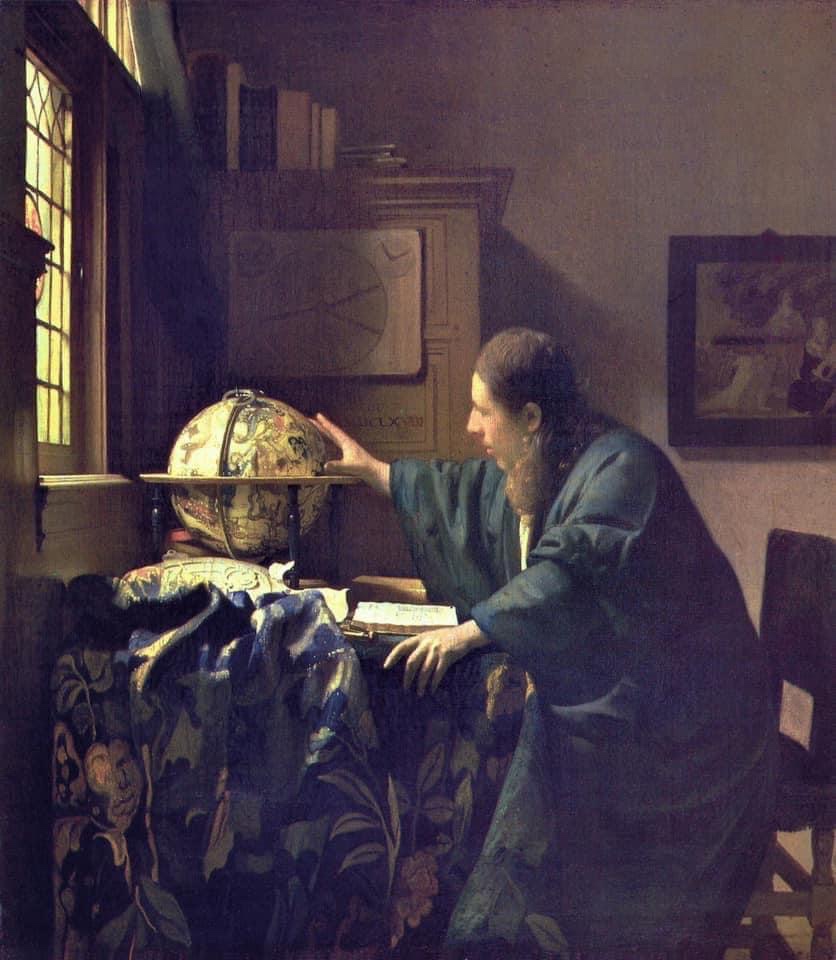
A young man in a dressing gown with a light complexion face and long fluffy hair, illuminated by a beam of light penetrating from the window, spasmodically observes a spasmodically reproducing sphere, leaning on his desk.
The attention with which, just getting up from the chair, makes him rotate that cosmic map as if he could find a confirmation of his calculations, is that of the scientist who estranges himself from the surrounding reality in order to focus only on his research, with his lips soggy in a motorcycle at the same time of question and amazement.
Around him, scattered here and there in clutter, here are the tools of the job: books, a graphic, an astrolab, and a compass.
We don’t know his name, because Johannes Vermeer, the great Dutch master who portrayed him, wanted to celebrate with him all scientists and especially astronomers who in the 17th century, starting from our Galileo, with their extraordinary discoveries and inventions allowed the Netherlands To be the first in the production of lenses and lenses.
For an artist who always preferred female figures, portrayed in their domestic privacy, the depiction of a man in the clothes of an “Astronomer,” which is from a pendant to that of a “Geographer,” constitutes a singular exception, justified by the importance attributed by Vermeer to scientists in general, that is to those who have always the fates of humanity move in the direction of progress.
The Latin animates the scholarly facts “curiositas,” that is, by “care, attention” towards natural phenomena and things of the world, and certainly by “curiosity” in the detriment of the theme, which consists of wanting to hang on the facts of others.
Thanks to this healthy “curiositas”, in millennials Man came out of the caves, erected the Pyramids and the Colosseum, wrote the Odyssey and the Divine Comedy, brought forth the Renaissance, lit the lamps, defeated diseases and deadly viruses.
Just to highlight the symbolic importance of his painting Vermeer exceptionally signed it and gave it with the motto “IVMeerMDCLXVIII”.
Accompany this writing “the Astronomer,” by Johannes Vermeer, 1668, Louvre Museum, Paris.
(Lyrics by Anselmo Pagani)

 The Haasienda on Shroyer...